We built the tool
we wished the boss already had.
Decisionlore exists because every growing Singapore SME hits the same wall: the owner becomes the single point of failure for knowledge the whole team needs. We built a way to capture that knowledge properly, and a way to keep it current.

The same three problems, at every firm we've looked at.
The owner is the bottleneck
New hires take too long to become productive
The knowledge walks out the door
Boss judgment should be capturable.
Most tools either dump documents into a search box, or bolt a generic chatbot onto your website. Neither one learns how you actually decide things. We built Decisionlore around a different bet: that a structured workshop plus a weekly correction loop can turn a founder's judgment into something the whole team can query.
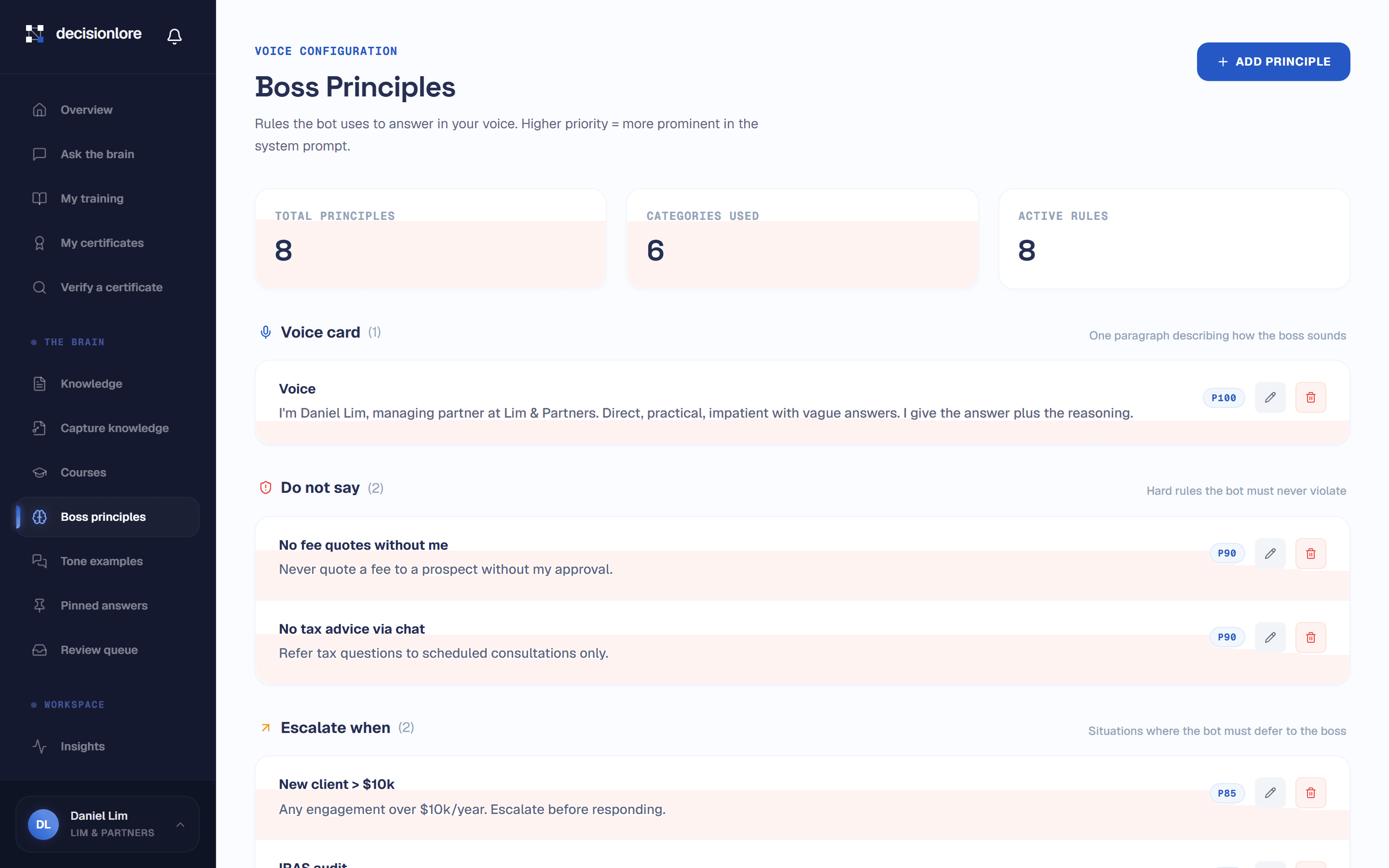
Product screens on this page show sample workspaces built to demonstrate Decisionlore. They are not paying customers.
Capture judgment, not just documents
The weekly review loop
Pay for the brain, not the seat count
Not just another chatbot
For the Singapore firms that live in judgment calls.
10 to 50 staff
Professional services first
Singapore SMEs
Your business runs on this. It shouldn't leak.
Decisionlore is hosted in Singapore and built PDPA-aligned from the ground up. Every tenant's data is isolated at the database layer, so your documents, decisions, and conversations stay inside your own tenant.
What that means →
- +hosted in the Singapore region
- +PDPA-aligned: export and deletion on request
- +tenant isolation enforced at the database, not just the app
- +audit log on every meaningful action
- +we don't train models on your data, ever

Freemansland Creatives Pte Ltd
Decisionlore is built and operated by Freemansland Creatives Pte Ltd, a Singapore-based company. There is no founding myth here: this is a tool built by an operating company that kept running into the same pattern across the SMEs it worked with, the owner as the single point of failure for institutional knowledge. Decisionlore is the tool that pattern demanded. The people who build it, run the workshops and answer your email are listed below, by name.
Decisionlore connects to Shomer, the evidence-to-competency platform by Freemansland Holdings Pte Ltd.
Questions about the company, the product, or a pilot? nick@freemanslandcreatives.com
7 people you can name.
Decisionlore is built, sold and supported out of Singapore. Scroll down to meet each team member and see what they are focused on.
Nick Tung
Chief Executive Officer
Operating out of our Singapore team, focusing on leadership & operations to ensure your firm's tribal knowledge is secured.
Serena
Senior Project Specialist
Operating out of our Singapore team, focusing on leadership & operations to ensure your firm's tribal knowledge is secured.
Emily
Project Planning
Operating out of our Singapore team, focusing on leadership & operations to ensure your firm's tribal knowledge is secured.
Dex Tan
Senior Business Development Manager
Operating out of our Singapore team, focusing on business development to ensure your firm's tribal knowledge is secured.
Merrin See
Senior Business Development Executive
Operating out of our Singapore team, focusing on business development to ensure your firm's tribal knowledge is secured.
Ivan Lee
Business Development Executive
Operating out of our Singapore team, focusing on business development to ensure your firm's tribal knowledge is secured.
Cariyn Poh
Business Development Executive
Operating out of our Singapore team, focusing on business development to ensure your firm's tribal knowledge is secured.

Nick Tung
Chief Executive Officer
“Building systems that let SME owners step back without operations or tribal knowledge falling apart.”
Our back-office runs on 7 specialized AI agents.
They draft, research, test and audit work behind the scenes. A real person from our Singapore team always signs off before anything reaches you.
The company that operates Decisionlore runs its own internal work on an AI workforce. Every name below is a software agent, not an employee. They draft, research, test and check work for the human team above. They do not hold accountability for your account, and a person always signs off before anything reaches you.
- +This is our own back office. It is not the assistant your staff talks to inside Decisionlore, which is trained only on what you approve.
- +One first name appears twice on this page. Dex is a real person in the team above and, separately, the name of an agent below. The AI mark is how to tell which one you are looking at.
Clara
AI Chief of Staff
Business Advisor
Refines core decision rules and logic parameters.
Financial Modeling
Builds cost-saving budgeting and seat structures.
UI/UX Interface Designers
Designs user onboarding flows and visual capability modules.
Dev Engineers
Writes backend builds, API configurations, and automation scripts.
Quality Assurance Auditors
Performs full-suite regressions and tests runtime parameters.
Security VA-PT Auditor
Audits security vaults and validates PDPA compliance keys.
7 people. 7 AI specialists. One team.
Common questions about Decisionlore.
What is key person risk in a Singapore SME?
It's the risk that a business's ability to operate depends on one or two people, usually the owner or a senior staff member, holding the judgment calls (pricing exceptions, client-fit decisions, how a clause actually gets handled) only in their head. If that person is out sick, on leave, or leaves the company, the business loses the ability to make those calls consistently. Decisionlore exists specifically to capture that judgment into a system the rest of the team can query.
Does this help with succession planning and knowledge transfer?
It addresses the knowledge half of it, not the whole of succession planning. The structured boss-interview workshop captures decision principles, SOP judgment, and tone of voice before a senior person leaves, so that knowledge doesn't walk out the door with them. It isn't a substitute for a formal succession or HR plan, but it's a concrete way to make sure the judgment behind that plan is actually written down and queryable.
How is this different from just writing SOPs in a wiki?
A wiki holds what's written down. It doesn't hold why a decision gets made a certain way, or the exceptions an experienced owner makes without thinking about it. Decisionlore's workshop is built to capture that judgment specifically, as decision principles and tone-of-voice examples, not just document text, so the system can answer the way the owner actually would, not just recite a policy.
See how it works
for your firm.
14-day pilot. 90 minutes of your time. We run the workshop, and you keep the result, even if you don't subscribe.